Film Noir Friday – You Only Live Once

(Possible spoilers below)

How have I never seen this film?

A noir purist will likely point out You Only Live Once as proceeding the Film Noir cycle of roughly 1940-1959. It is noir maestro Fritz Lang’s second American film, and if anything it is an argument for pushing the beginning of the noir period back to 1937. I know noir, when I see it, and this is clear-cut noir, and a fantastic film.

Henry Fonda plays an ex-con trying to go straight with his new wife (played by Sylvia Sidney…and look at that top billing all the way back in 1937!). Of course, this is noir, so it’s not as easy as saying I’m getting out of the life. Fonda is wrongly accused of a bank heist, and finds himself on death row. There’s a VERY compelling prison escape… that is so noir I can’t even go there and spoil it…watch it and you tell me. The priest? Fuhgeddaboutit.

The film wraps in pure fashion (which surprised me, quite frankly), and did it at about the 80 min. mark.

In closing, I’ll also point out that there is a lot of prison shots, which always makes for wonderful film noir, chiaroscuro visuals. If you’re a fan of the visual-style, you can’t go wrong here.

–TD

What I am Reading – Hardman

Ralph Dennis has a bit of a cult following among fans of hard-boiled crime fiction. I first came to hear of him through an excellent entry on the Hardman series on Paul Bishop’s blog. And I immediately began searching Used Book stores for books in the out of print series.

I go to used bookstores a lot… it’s like an addiction. Yet…

I have never seen a copy of any of them.

Ebay and other online retailers will occasionally post copies for steep prices.

For about the two years I’ve known of the series, I’d pretty come to think of these books as a Golden Ticket.  Then something wonderful happened, Brash Books has gotten permission or rights or whatever to re-publish Dennis’ works. And they’ve started with the first five Hardman books.

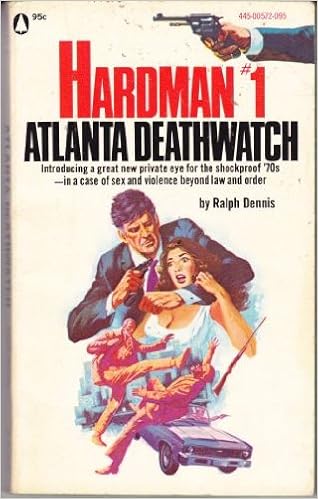
My copy of Atlanta Deathwatch arrived on Christmas Eve.

The book includes an excellent introduction by Joe Lansdale, which makes a claim that the Hardman series suffered from the original publisher marketing it as a Men’s Adventure series (ala Mack Bolan The Executioner). The Hardman series was even “numbered” 1-12.  Having read the first book, I can see the problem with that. Dennis’ prose is strong in a leaning toward Chandler way. However, I also see how it gets lumped in with Men’s Adventure (which I personally do not think of as a knock on the books). There is a tendency toward more violent action than you find in the typical Chandler or Ross MacDonald yarn. I think it goes beyond John D. in that regard, too…but it seems a little closer to a McGee story than a Marlowe. This is what my wife would call a “boy book.” Make no mistake about it.

Fortunately, I like “boy books”. One could argue that’s what I just wrote. But how is Atlanta Deathwatch?

It is fantastic. I’ve learned few things live up to the hype. Prior to Atlanta Deathwatch the last thing to live up to the hype was the Solar Eclipse.

Atlanta Deathwatch is the story of Jim Hardman (how’s that for a hard-boiled detective name?), a discharged ex-cop, and his buddy Hump, a former pro football player. Hardman is hired to follow Emily Campbell, a Georgia Tech co-ed who’s grades have tanked. Hardman follows her right into trouble at an African-American bar. The kind of trouble that leaves him pissing blood. Hardman’s no idiot, so he begs off the case. When Emily is found dead shortly thereafter, Hardman is drawn back into the dark underworld of Atlanta’s “Black Mafia.”

And we’ll leave the synopsis at that.

I love the Hardman-Hump relationship. The Black-White buddy thing worked in the Spenser novels…and it works here, too. Which leads me to wonder (and I’ll probably go look), which came first?  Spenser/Hawk or Hardman/Hump.  I generally don’t plan out much of my own stories, but I am fascinated where stuff comes from…and have often wondered whether my Uncle Rod/Fuzzy came from my love Spenser/Hawk (even if Uncle Rod is more like an African-American father figure)?  It certainly didn’t come from Hardman/Hump, but only because I did not know about them.

The pacing is great. I read it over two nights, which seldom happens anymore. Dennis masters the balancing act of providing enough depth, but not burying the reader under needless details.

If you are a fan of “boy books”. Give Hardman #1 – Atlanta Deathwatch a try. I look forward to reading more of Jim Hardman’s adventures.

Thank you Brash Books for bringing  these back!

___________________________________

If you’re interested in seeing what my “boy book” is all about. Give Everything is Broken a try:  https://tonydwritespulp.com/books/

It’s follow-up North Country Girl is coming in January 2019.

2019 Writing

Jan 2 – 379 words

Jan 3 –  456 words

2019 Total – 1,566 words

Theme

Okay, I know I said I wasn’t going to write about 2018. But there is one thing I’ll share.

One of the most pleasing things that has come out of publishing my first book was my son reading it and doing a book report* on it for school. When I was publishing Everything is Broken, I mentioned that hearing my wife talk about my characters like they were real people was probably enough to keep me doing this even without any sales. My son is anxiously awaiting North Country Girl’s publication, because he wants to read it for his next assignment. Folks, it doesn’t get much better than that.

But let’s reflect on the last assignment. Dylan and I were out walking the dog. He had just finished reading the book, and he asked me about the book’s theme.

Oh brother.

Here’s the thing. I try NOT to start out with a theme, because I feel like it cages the story. As someone who defiantly does not outline, caging the story is exactly what I do not want to do. Of course, high school English teachers do not want to hear any of that.

So, I told my son the truth, but added, “pretty much all of my stories see a couple of themes show up. Those two themes are fatherly love and the tendency of our pasts to have a ripple effect on our presents and futures.”

Dylan nodded his head, “Papi.”

Yep, fatherly love.

But I could see him struggling with the other.

I helped him out, “Pretty much the entire Fuzzy Koella character embodies the second theme. But I don’t set out to tell stories of these themes. It’s just obvious that I am interested in them, and that shows up in the stories.”

“Dad, I think I’m going to go with the theme that’s right in the title.”

Proud papa moment coming.

“We’re all broken in some way, and Fuzzy learns the hard way that you can’t fix everything. Sometimes trying to fix things only makes them worse.”

Yep, fatherly love.

*It’s called something different today, but it’s basically a book report.

–TD


If you’re interested in finding out how close Dylan and I got on the themes of Everything is Broken it can be purchased at these fine online retailers:

books2read.com/everythingisbroken

It can also be ordered by your friendly local bookseller.

2019 Writing

Jan 1 – 731 words

2019 Total – 731 words


A New Year

You’ll have to excuse me if I don’t revisit 2018. I reflected on 2017 last year. I just don’t see the point this year. However, I will layout some goals for 2019.

  • Write 350,000 new words of fiction. (This is a little less than a 100k bump from 2018).
  • Write one book in a genre other than Mystery
  • Read every day at least one of the following
    • A poem
    • An Essay
    • A short story

I hope all of you (friends, readers, curious on-lookers) have a fantastic 2019!

*and take a look at my friend David’s recent post regarding use of pronouns. Food for thought.

–TD


fireworks photo
Photo by Peter Spencer on Pexels.com

What I’m Reading – Smith’s Monthly

Smith’s Monthly is/was a crazy cool concept by Dean Wesley Smith. It was a literary magazine (currently on hiatus) that was filled with short stories, poems, non-fiction essays, and novels (one per issue) every month by one writer. 70-85k words of fiction published every month…it made to something like 40 issues. And it may pick up again.

I knew nothing of Dean or this magazine when it launched in the fall of 2013, but I became intrigued by it after I discovered Dean’s blog. I like the pulp mindset of production, and this seemed like the pulps resurrected. So, I recently ordered #1.

It is exactly like advertised. A handful of short stories, a couple of starts of serials, an essay of first tee jitters (golf), some poems, and an entire Post-Apocalyptic Romance novel. I enjoyed the shorts a lot, which is saying something because I generally prefer reading longer fiction.  The golf essay was humorous, if only because I felt like I was laughing at myself.  The novel wasn’t my “thing”, but was well written and I believe someone who likes their genre-romance hybrids to tilt more to the romance side would like this a lot more than I did. I liked it, just wasn’t necessarily in my reading ‘wheelhouse.’

The beauty of Smith’s Monthly is that there is a ton of (mostly) new fiction and it touches on every imaginable genre. I find that admirable as both a reader and writer. I look forward to continuing my way through the issues. That’s a lot of reading ahead.


Interesting things About Interesting Links

The links of interest over there to the right —>.

Why are they of interest?  There are a number of reasons.  Here are some:

The Magical Kingdom:  This is the web home of writer L.M. Warren. I know L.M. through a local writing group. I’ve only run into him two or three times, but we get along pretty well…for a couple of socially awkward introverts (okay, so I’m speaking mostly for myself).  Why should you care?  You should care because he’s a damn good writer. If you’ve watched Shrek, and been intrigued by how the creators played with some of the traditional fairy tales, but wish they had gone a whole helluva lot further, a lot darker, with more bite to the social commentary…then L.M.’s your huckleberry.  Now, Shrek is a horrible comparison… L.M.’s work is dark, literary satire at its best. If you know me, you know my sense of humor is a little off… this is turned to 10.

Dean Wesley Smith: Outside of Chris Baty, Dean is probably more responsible for any success I’ve had than anyone. His “attitude” posts have changed my world view even outside of the writing. His Writing Into the Dark is essentially a playbook for my writing process. I learned of Heinlein’s Rules through his blog. Dean rubs some people the wrong way, because he calls bullshit on a lot of beliefs that writers worship. For me, (most of) that myth busting was liberating. The guy also happens to be so giving of his time to help beginning and beyond writers. Even if he pisses you off, if you haven’t visited his site, you owe yourself some time reading through the archives.

Harvey Stanbrough: A modern pulp fictioneer. Harvey reports out on his progress on his writing projects daily, and typically blogs about the writing life daily (in the journal). His “Of Interest” section always links to interesting articles out in the writers’ blog-o-sphere. Harvey has written something like 35 novels in the last 4 years or so, and 100 (?) or so short stories in that time. It is the kind of prolific output I admire, and hope to attain. I haven’t read any of his work yet, but I intend to in the New Year. Why don’t you join me?

Michael LaRonn:  Another prolific pulp fictioneer. Michael holds down a full-time job, and fills up every sliver of free time with writing. His mindset is positive and contagious. I enjoy his podcasts and you tube videos.  He has an excellent video regarding Dean’s Writing into the Dark book. The passage that Michael refers to as a little “hippy” is exactly why I love WITD. It’s also what I love about Michael. If you struggle with negativity about your writing, carving out time in your busy days, fears that you might “not be good enough”, check out Michael. He’s got the antidote.

The Everyday Novelist: A fantastic podcast for Nanowrimo and beyond. The concept of this podcast is taking the idea of Nanowrimo and bringing it forward into the other eleven months. The first 30 in the series will walk you through the thirty days of Nanowrimo…but don’t stop there. There is a lot of great ideas on turning this writing gig into a 365 day a year thing. And importantly, how to do quality work while you are also working on the quantity of work.

Aila Stephens: Another writer I know from the local writing group. Aila writes in a genre outside of my tastes, but I’ve read the excerpts and she’s a quality writer of Women’s Fiction. But that’s not why I’ve linked her here. She also has a fantastic blog. Check out her series on DIY Book Covers.

Paperback Warrior: I love to read. Duh? I write, of course, I love to read. The Paperback Warrior posts regularly on the kind of books I love to read. Pulp, Noir, Detective, Westerns, Men’s Action, Sword & Sorcery…basically, all pulp goodness. The Warrior regularly grows my Mt. To Be Read. I’m not sure if I should thank him for that or not!

Merry Christmas, everyone!

–TD


A Christmas Offering – Free Books

I have a couple of dinged up copies of my book Everything is Broken. They came from the printer this way. I think they tried to jam a couple more books into a box that wasn’t large enough. The books are fine, tight bindings, no tears, etc. Just enough creasing to the covers that I wouldn’t feel right selling at full-price. I originally thought of posting them for sale at my cost.  Now, I’ve settled on just offering them up.

All you need to do is request one, either here or on the Facebook Page or Twitter (wherever you see this).  I’ll send them out to the first two respondents (in the United States).

I do ask a couple of things:

  1. Only request if you intend to read it. Seems like a silly request.  But honestly if you just plan to toss it on a shelf, please let a reader claim the book.
  2. If you enjoy it, please tell a reading friend about it or even better let them borrow it.

That’s all. No shipping costs. No sign up for a newsletter list. Just read it, and if you like it tell a friend.

If you don’t manage to “win” one of these, the mighty Zon has discounted paperbacks of Everything is Broken by greater than 40%.  Their decision. So, I have no idea how long this sale will last. On top of that, I believe you can include it in their current promotion $5 off $20 or greater book purchases (obviously only if you purchase other books).  Coupon code for that promotion is: GIFTBOOK18.  The favor of a fair and honest review is requested, if you take Amazon up on this sale.

–TD


You Must Finish What You Start

Confession Time.

I first participated in NaNoWriMo in 2001.  I don’t think I succeeded in the challenge until 2005 (?). I repeated in 2006 (?).

Honestly, that isn’t so bad a record. So, what’s the confession?

Both of those books I stopped writing after crossing the 50,000 word line.

And never finished them.

If it isn’t obvious, the topic of this post is Heinlein’s Business Rules of Writing #2. As universal a truth Rule #1 is (You Must Write), #2 is almost as much of a no-brainer. There is very little market for uncompleted stories. You Must Finish What You Write.

To do this you have to learn to shutdown the critical side of your mind. We are quite literally the worst judges of our own work. To finish, you have to abandon the pursuit of perfection. You have to work all the way to the finish line. It is only then that you have any hope of selling your work (with few rare exceptions, and even those sales disappear  if you don’t hand over finished work at some point).

Professional is a word that gets batted around a lot. I won’t share my pet peeve on the use of the term.  I will say that a professional completes the job.

Next time, you are picking at the scabs of your work in progress, ask yourself if you are working toward the finish line or just using the editing, rewriting, “polishing”, etc as an excuse to not finish.

Back to my confession, my problems were two things:

  1. I bought into the sloppy first draft myth. In my subconscious mind, I understood that I hadn’t honored my creativity. I hadn’t let it do its thing. Instead I told it, “Fuck around. This isn’t important anyway. Only a first draft. I’ll need to go back through three or four times anyway.”
  2. I bought into book as event thinking.  NaNoWriMo by its nature promotes this. The event was reaching 50,000 words in a month. When the event was over, I shut down.  I never stopped to ask myself,”Why just November? If I can write 50,000 words in November, why not every other month in the year?” (For the record, I only wrote 30,000 words this November. BUT, I have three other “NaNoWriMo” months on the year, where I did manage 50,000 per month.)

I am not one who knocks NaNoWriMo. Chris Baty (NaNo founder) has been as great an influence on my writing, as just about anyone. Back in 2001, I didn’t take his “No Plot? No Problem” to heart. Today, I live by it. However, like just about anything else, you have to take what works for you, and leave behind what doesn’t. Sloppy drafts is a sure fire way to keep me from finishing what I start.

Heinlein’s Rule #2 is not something you can leave behind if it doesn’t work for you. If you want to be a commercial fiction writer, you must finish what you start. If you struggle with this, some self investigation is in order. What other myths or bad habits have you bought into that have become a road block to Heinlein’s Rule #2?

–TD


“Basically, it’s fun”

A couple of months ago the New York Times published an interview with writer Haruki Murakami. It was a fascinating interview, because Murakami spoke frankly about writing in a way most writers don’t. Especially “literary” authors like himself.

The article is worth searching out if you have not read it.

What has remained with me the most over these last couple of months was Murakami’s answer to a question regarding the difficulty of the writing process. He jukes and jives a little in answering the question, but then lands on how his mind is at ease during the process, and that “basically, it’s fun.”

Any writer who has spoken to me about writing knows that “writing is fun” is my mantra. I’m not talking about finding the time to do it. Or figuring out the business end. Or querying agents. Or establishing a platform. Or participating in peer critiques. Or researching markets. Or any of the other crap. I’m talking about sitting down, and making shit up. Or even better, sitting down and recording all the cool shit your characters are doing.

Writing is NOT hard.

It is FUN.

Over and over and over I hear and read writers moan how it’s hard. It is NOT. It is play. And if you think it’s hard, spend some time next summer watching roofers work in the 90F+ heat. Spend some time at a hospital and watch a nurse pull a 16 hour shift. Consider boot camp for any of our military…or even harder, the tasks they may be asked to do to defend us.

The story that you are struggling over, and have for a year? Not hard. Finish it, and write another. I assume any fiction writer that has taken on writing has done so because they love a good story. Reading a good story is fun. Creating one is great fun. Don’t make it hard. Don’t make it special. Keep it fun.

Because, “basically” it is.

–TD

What I’m Reading – Kristen Lepionka

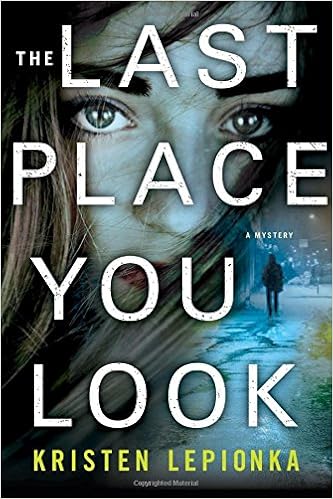
Surprise. Surprise. I’m reading a live author.*   The Last Place You Look by Kristen Lepionka won the 2018 Shamus Award for Best First Private Eye Novel. I know it’s un-hip to consider award winners, but the Shamus Awards happen to give me ideas for new private eye authors.

So, what about the book?

Roxane Weary is a bi-sexual, cop’s daughter, borderline alcoholic private eye with Daddy issues in Columbus, Ohio. She feels like a real, breathing person… but layered with enough of the mythical private investigator archetype to keep me interested. She isn’t so tied to ‘realism’ that we watch her spend 200 of the 300 pages of the book doing web searches.

If the above description of Roxane gives you pause. Let me say there is no political, or social justice posturing here (I am bleeding heart liberal, so maybe it can’t see it). Roxane is just the person I described above. Lepionka does an excellent job of not turning this into didactic fiction. It’s a detective story.

And it’s a good one.

Roxane is hired by a woman, whose brother has two more months on death row. The woman believes she has seen the missing daughter of the two people the brother was convicted of killing.  Simple case, find the mysterious missing daughter (hadn’t been seen in a decade). Like most good PI stories, the set-up case is just a trigger to drop the detective into a bigger, more dangerous case. The Last Place You Look has that in spades. There is a key element of the case that really isn’t my thing. I can’t share that without spoiling the book. However, I will say in Lepionka’s hands that quibble disappeared. This one has a truly effed up (in a good way) ending.

I look forward to reading the next in the series.

–TD

*I also read another indie author’s book, too, but it was a lot more literary than I write about here, and I’m not sure I’m worthy of writing about it