Film Noir Friday: Odds Against Tomorrow

MV5BOTY5YjMzNjQtZDJiOS00ZTUyLTk5ZGMtZTI3ODBmYWQzODJmXkEyXkFqcGdeQXVyNDcxNDkxMjA@._V1_SY1000_CR0,0,663,1000_AL_

My wife and I for a short time would sit down and watch a Film noir every Friday night. We called it Film noir Friday. Now I run Dungeons & Dragons for my 15-year-old son and his buddies on Friday nights. With the amount of writing I’m doing, and the other stuff entailed with publishing, and working at least 40 hours per week at the real job, and reading (critical to writing craft), and ensuring I leave four hours every Saturday to watch my Alma Mater, I don’t get a lot of time to watch old movies (or any movies).

There will not be a Film noir Friday this week, either.  But—, TCM’s Noir Alley series is screening Odds Against Tomorrow (OAT) this weekend (Sun 12 a.m. and 10 a.m. EST).  This is a notable entry for two reasons:

1) It is IMO the last film of the original Film noir cycle. Many experts claim the cycle ended in 1958 with Orson Welles’ Touch of Evil, but I’ve seen none of them deny that Odds Against Tomorrow is a Film noir.  This is not a comment on the relative merits of the two films. My only argument is that Odds Against Tomorrow released in 1959 is a Film noir and should rate as part of the Classic period.  For example, it is not a neo-noir like Chinatown. (If you are interested at all, I prefer OAT to Welles’ film)

2) It is one of a handful of classic Films Noirs to tackle the race issue. I know talk of race issues in the USA (and global) is exhausting. However, it is fascinating to look back.  Back to a time before I was born from the perspective of someone who grew up in the 70s and 80s. I think it’s common to think these scabs weren’t picked at in the 40s and 50s (or maybe that’s just my narrow perspective?).  But there were a few noirs that tackled it before or in the early days of the escalating civil rights movement.  Crossfire (anti-Semitism) and No Way Out, come to mind. And OAT. I’ve seen these movies, but it has been years. I think I own Crossfire and I know I own OAT. I forget movies like I forget my own stories when I’m through with them (ask my wife, she knowsmore about what happens in Everything is Broken than I do!). But I am left with the impressions.  And I recall Odds Against Tomorrow as the best race picture of the Noirs I’ve seen, and I recall Robert Ryan as being believable and fantastic as a disgusting racist.

I own the DVD, but I’m hoping to catch the Noir Alley screening to hear what Eddie Muller has to say about the film. If you haven’t seen it, check it out. The message hides in pretty good heist film, so even if you are tired of race and don’t share my fascination in looking back on the issue I think it is enjoyable on those grounds alone. Plus, it features Gloria Grahame in a small role. Gloria is always a good reason to check out a film.

Why Pulp?

I’ve received some interesting messages this week which basically amounted to Why Pulp?

Seemed like a worthy blog post.

The answer is pretty simple. I don’t intend to wade into the literary waters. I enjoy reading literary fiction, but I have little desire to write it. I suspect I will always be simply a genre writer. The original pulps were the popular genre fiction of their day. I think there is a tendency to think pulp was, I don’t know, Indiana Jones-type stories. I love those stories. Love. But the pulps were also filled with detective stories, westerns, romance, sci-fi, weird horror, and the list goes on. So, when I say “writes pulp” I mean “writes genre fiction.” But there is more…

The pulp writers were also very prolific. They had to be at a penny (or fraction thereof) a word. They didn’t labor over a novel or short story for a year to make sure it was perfect. A polished story was the least of their concern. This led to a reputation of poor quality, partly because there was some. (Guess what? There are quite a few stinkers on the shelves of your local Barn o’ Novels.)  However, Charles Dickens was, for all intents and purposes, a pulp writer. So was Raymond Chandler. Dashiell Hammett. Edgar Rice Burroughs. H.P. Lovecraft. Robert Howard. Tons of others who wrote great stories without as much name recognition today.  They wrote a million words a year, and they got better at telling stories because of it.  My favorite author John D. MacDonald got his start in the pulps. He famously once said a writer had to get a million words out of his/her system before he/she produces anything of quality (I paraphrase). I believe in the value of practice. I believe in the value of being prolific. I do not worship at the altar of continually revising a story to make it just right.  Especially, early on in my writing journey.

Why?

Simply put, I think I’ll learn to be a better storyteller by telling more stories.

I have no better answer for Why Pulp?

Social Media

As pointed out in the comments, I’ve been slow in linking Social Media. This is partially because the only social media I ever use is Facebook, and that’s just a personal profile.

I created a Facebook Group, which once I actually get something out I will use like a newsletter to announce releases, interact with readers… and maybe even provide the occasional freebie. I am not a marketer. I am not a salesperson. It all makes me very uncomfortable, but at least people will know that by joining the group they will receive promotional stuff.  Which beats me using my personal profile like it’s some MLM.

Facebook group:

https://www.facebook.com/groups/anthonydecastropulp/

So… I had hoped to avoid a Facebook “Page”, simply because it seems to have turned into a tool for Facebook Ads. I don’t necessarily have anything against the Ads. I may get around to using them, but that is somewhere down the line.  The thing I like about the Group?  If someone signs up, unless they un-follow, they should get notified of anything I post to the Group.  Not so, with the Page. Only a percentage of those following the page will get notified…unless I pay to Boost the post.  But… Facebook as of August 1st only auto-links WordPress posts to Pages, not Profiles…not Groups.  So, I have a Page, too! (as of 30 minutes ago, and I’m already getting propaganda from Facebook to pay for boosting).  I do have a Page. Please be sure to “Follow”. Hopefully, that means you have a better chance of getting notifications.

Facebook page:

https://www.facebook.com/tonydwritespulp/

or @tonydwritespulp

Finally, Twitter (sigh). Twitter is a complete mystery to me, but I do have an account linked to this page.

Twitter:

@decastro_tony

If that is not enough social media, amen.  For this is all I am capable of at the moment.

And thank you to reader, L.M. Warren for gently nudging me in the direction of linking my social media to the page.  I have no clue whether any of this will work properly, but nothing ventured, nothing gained.

–TD


Fears and What I’m doing this Weekend


On my calendar this weekend I have formatting the e-book and paperback for Everything is Broken.  I also have a Drive-by Truckers concert to attend in Atlanta. Seeing DBT live (and Bob Dylan) is like a religion for me. So, I won’t be missing that. I also have the very important task of spending time with the family. I’ve always struggled to minimize the effect of my writing pursuits on my wife and son. I have always hoped that they would not need to sacrifice for my passion. I fear that lately I have failed. Not miserably, mind you. But there is no way around the fact I am stealing time away from them in the evenings doing someIndie-writerly things.

Further on fears… I am getting into unknowns. The actual publishing side of things. I tell myself that the uncertainty I feel is just the discomfort of doing things I have never really done before.  The truth is much darker.

I am struggling with Heinlein’s Rules #3 and #4.

3. You must not rewrite (unless to editorial order)

I don’t have an editor to order me to do anything. I’ve made typo fixes found by my first reader (my wife) and a copy-editor. That’s it, right? Damn, while I scanned the book formatting for e-book I noticed a typo they both missed! And this is the dark, downward spiral of Rule #3. I’m fighting the good fight, but it is very hard to not succumb to the temptations of rewriting (to death).

4. You must put it out to market.

The butterflies here are just about the same as getting up in front of a crowd and speaking. I’m an introvert, and that terrifies me. However, I am grasping onto what I’ve learned in my professional life, where I have learned to dive into the deep-end. When an opportunity arises, I volunteer, get the public speaking over with, and breathe a sigh of relief. I’ve gotten good at presenting to fairly large audiences. I will remember that and try to sprint to hitting the publish button. Then forget it and don’t read reviews if any of them ever come in. Ha ha. The key to that sprint, however, is making it to the other side of Rule #3.

Good news? I slept in until 7 a.m. today, but still got my morning words in. Tomorrow will me more difficult as I’ll be up till God knows when in the House of Rock. And somewhere in there, I need to finish formatting books. The e-book is pretty much there, I need to draft a copyright page and figure out how to get the free ISBNs input on my book from the retailers that require ISBN (and I have no clue about that, God help me if these D2D and others don’t have weekend customer support).

Have a great, prolific weekend.

Gatekeeping

When I first attempted Nanowrimo more than fifteen years ago and by extension started down my fiction writing path in earnest, there was no feasible method for Indie publishing. There was the start-up publisher iUniverse (and probably some others), who I credit with bringing visibility to the idea of print-on-demand technology. Ebooks were these clunky, really irritating things that maybe you could read on your computer or some geeky device that cost several hundreds of dollars.

The idea of self-publishing was even more frowned upon than it is today, but more importantly there was very little chance of reaching any level of success through self/indie-publishing.

Back then you had one choice — traditional publishing. And traditional publishing like any dusty, backward looking business model came with its “always done this way” rules. Some of those were:

You must have an agent. The big Five do not take non-agented submission.

No simultaneous submissions, unless the publisher specifically allows it.

I’m not going to comment on the stupidity of that simultaneous submission rule, other than to say I never followed it. Because, fuck ’em. They wanted months on end to read the submission. Even when I was 32, I didn’t have the time for that bullshit.

The agented submission is another form of bullshit that lives on today. The agents have been and continue to be gatekeepers to gatekeepers (i.e. agents -> publisher -> reader). They (agent and traditional publishers) argue that it keeps low quality work off the market protecting the reading public. In those days, I remember thinking how the indie music scene took off by cutting out the big-time record labels. Publishing has followed suit despite the best attempts of the Big-Five and agents.

There was another aspect of this agented submission requirement that was none so savory (I suspect it continues). The scam agents. Writers, so concerned that no publisher would read their submission, became easy prey to agents who would charge the writer for agent services. Disgusting.

Alas, in today’s market, where writers have taken some initiative in the markets, a new type of gatekeeping has arrived.  A new scam is breeding.

Today with the popularity of indie publishing, all of the ‘experts’ are warning of the lack of quality. The reader must be protected. NOW, every indie writer ‘must’ have their novel ‘professionally’ edited (editorial direction, developmental editing, copyediting, proofread), and they must hire a ‘professional’ book cover designer, and possibly ‘professional’ book formatting. Most of the individuals who have set-up shop in any of these cottage industries are ‘professional’ in the same way the women of the world’s oldest profession are. Which is to say, there are no professional requirements for any of these people to provide their services. Yet, nearly everyone in the industry, including fellow indie writers, claim all of it is necessary. I just received an email from Reedsy that suggests the average costs for just the minimum editing (see all that bullshit in the parenthesis above) is greater than $4000.  Formatting approx. additional grand. Same for cover design. The cost of all of these ‘required’ quality assurances is the new gatekeeper! I don’t think I need to tell you what the scam is…

This is bullshit.

Do your best. With what you can afford. Do not be deterred by this bullshit. It is all capitalizing on writer/artist fear. If you can afford a copyeditor and you don’t have a free resource, by all means purchase the service (but research credentials). If you can afford a cover artist, and you can’t do a good job of it yourself, have at it (but check the portfolio). If you can afford a formatting help, keep that money in your pocket or give it to me.

Don’t let these costs keep the gate closed. Almost all of them can be minimized or eliminated with a little creativity. And some of it should not be used (book doctor, cough), period.

And by the way, call bullshit on all of the advice I just gave, because what do I know? But do think for yourself, because you are the only one that has your interests at heart.


A Night with Writers

My local writing group met at a pub last night for our “Pub Night.” Go figure. It’s the less formal of the meetings that the group has every couple of weeks. The other being “Critique Night”, which I do not attend. Despite the fact that I don’t participate in critiques this group has still been welcoming of me. And the Pub Nights give me what I need or want from a writer’s group.

I am able to check in with how I am doing on my work, and I am able to talk with other writers, which is fascinating. I always come away from Pub Night, excited and re-charged.

Last night, we discussed Indie Publishing.  I tried to mostly listen and talk less… I failed miserably. I guess I’m just too passionate about all this. Still, it was great to hear how our other writers have had success with publishing. What’s worked and what hasn’t. That sorta thing.

And I did come home excited and re-charged. Everything is Broken’s copy edits are complete. Now it’s time to learn about book formatting…

It’s Been Awhile

I suck. I know. Fortunately, I never really harvested any readers before disappearing. I’m going to try to get better…

So what’s going on?

  1. I’ve failed miserably on the Bradbury reading goals. I still think it’s worthwhile, and I do pick up a book of poetry or short stories or essays on occasion. I believe in Bradbury’s advice. I just haven’t committed to it.
  2.  I also set a goal of 250K words this year. Today I sit at roughly 130K words. Yes, more than half the year is gone, but I can still see this as do-able.

What else?

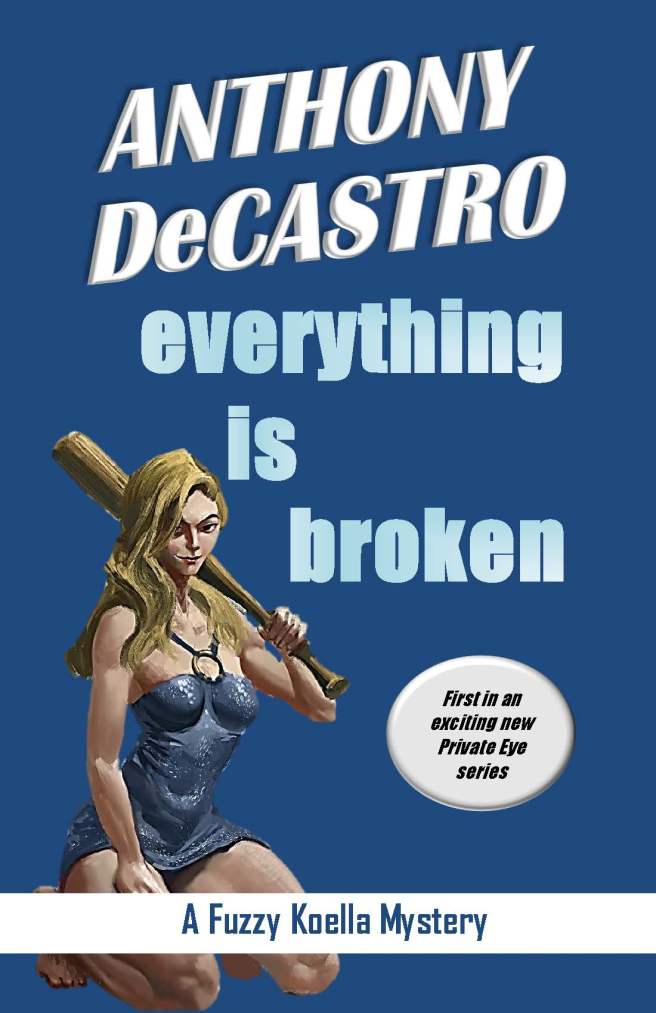
I see my first novel getting published this year. The title is Everything is Broken and it is a pulp detective novel. Hopefully, it will find some readers.  My wife loves it. I will try to remember that.  Because, honestly, if I can write stories that my wife loves to read, that may be enough motivation to keep doing it. I admit having her talk to me about my characters like they are real people is really, really satisfying.

coverpractice7


The second novel may get out this year, too. I am circling around the climax of that one like a turkey vulture does road kill.  Its working title is “North Country Girl.”  It is the second in a series beginning with Everything is Broken.

I have many other aspirations, but I’m gonna keep it real. I have Book 1 in editing, and I’m heading down the back stretch on Book 2. I’ve sucked as a blogger in 2018. A writer? Not so much, at least not from a productivity standpoint.

New Year, New Challenges

2017 was probably the toughest year I’ve experienced since 2003, the year my son was born.  As tough as 2003 was, though, it all turned out ok.  My son was born with kidney issues, and it was very hard times.  My son was sick, and having multiple surgeries. I was dealing with the kind of health insurance horror stories that politicians roll out during election season.  On top of all that, I was struggling financially to keep us above water due to those previous explained challenges.  But my son is healthy today, and as tough as 2003 was, I would wade through all that shit again to end up with the same result.

2017 is harder to see as anything but a long trod through an ever darkening swamp.  I can’t imagine ever looking back at it, and thinking I’d do it over again… certainly not for the same results.  I lost my Mom to cancer.  A few months later, her brother, my Uncle also succumbed to it.  If that wasn’t enough, within 2 hours of my mother’s death, a family member called me upset because Mom left some of her life insurance benefits to me.  Really upset.  Greed, ugh.  So, yes, 2017 is over and good riddance.  Let’s forget about it…except for maybe telling my mom, “I love you” one last time.

Writing hasn’t been going so hot lately, but I can control that. I spent the last week (I was off work), thinking about what I want to accomplish with my writing and education as a writer.  Obviously writing has to be part of it.  What about the education?  As much as I’d love to take some of the workshops out there (especially those offered by professional writers), I just don’t see me being able to take on the costs right now.

So what about writing books?  I’ve got plenty of those, and have read many of them.  I’ve noted a real danger in them.  Actually, more than one danger.  They are:

  1. Information overload.  If I were to challenge myself to read say 12 writing books over the next year.  The amount of advice would be a burden to the actual writing.  Why do I say this?  Because I’ve lived it.
  2.  The books are filled with rules.  Where is the fun in that?
  3. Inevitably, some of the rules contradict each other.  WTF.

There are some good books out there, but I’m going to go another way, rather than try to luck my way into one or two gems out of a dozen.

The late, professional writer Ray Bradbury suggested that beginning writers read for 1,000 consecutive one of each of the following :

  1. A short story
  2. An essay
  3. A poem.

His reasoning is that if you fill your brain with this much reading, you will never lack for ideas (and my adder to that is you will probably learn something about good — and bad — writing).  So I’ve started that streak, as of yesterday.  I don’t know if I’ll get to 1000 on the first try, or ever.  Life has a way of throwing rotten lemons, that aren’t sufficient for lemonade.  But, when I fall off.  I’ll just stand up and dust myself up and start a new streak.  I hope I’ll still be able to continue to read novels, but right now the focus is the above streak.  That reading comes first.

In the same spirit of the streak, I’m going to start a 5000 word/ per week challenge.  This, too, started yesterday with 1000+ new, relatively clean words on my current novel in progress, “Heaven Ain’t Bad.”

I will report out every Sunday night on how these challenges are going.  Right here on this blog, that nobody reads.

The overarching goal for 2018 is 250,000 new fiction words (this blog does not count).  Hopefully, that will generate 4 novels.  I will get at least one of those published and up for sale.  I’m setting the bar pretty low on the publishing part, because that is all new to me.  I will have to learn, and I want to guard against becoming so consumed with this part of the process, that it hinders the writing.  Right now, the most important thing I need to do is write. Practice. Get better at telling stories.  The writing takes precedence over the reading, but I also acknowledge that a writer must read.

2018, you are here.  And so am I.



What this is all about

Once upon a time, I realized I enjoyed writing.  I’m not sure I can isolate when.  Was it when I joined the School Paper in Middle School?  Or was it when I secretly wrote stories in my notebooks while I was supposed to be listening in Chemistry class in High School?  Was it when I jotted snippets of stories in a notebook while on the road with my college baseball team.

It was probably earlier.  It was probably when I realized that I enjoyed reading.

About ten – fifteen years ago, I began writing in earnest.  I participated in National Novel Writing Month annually.  I even wrote to completion on a couple of novels.  I took a Creative Writing class at the local Community College.  I joined and participated in writing groups.  I read like a demon every book, website, magazine on what it took to be a writer.  I was impassioned.

A couple of problems led to me letting it all go.  Namely:

  • Over consumption of all the expert advice had me spinning my wheels. A lot of the advice contradicted itself, and I probably lacked the self-awareness to identify which, if any, of these rules could apply to me. Some of the advice, made writing not fun.  Looking back, it seems that should have been the telling thing for me.  Any advice that took the joy out of something I enjoyed doing, should have been ignored.
  • Sharing my work.   Ultimately, we tell stories to be heard/read.  I never got in the habit of sending my work off for fear of rejection.  This is something I still must conquer.  A lot has changed in the 7-8 years since I was writing earnestly.  I suspect I will be going directly to readers with novels.  Shorts, I probably will be collecting rejection slips.  When it’s all said and done, I still have to face the fear.

I want to write, though.  And I want to have fun doing it.  I want to write the stories that I enjoy reading.  I want to get better, too.  And to do that I will need to practice a lot.  So Pulp, it is.

The Pulp writers wrote tons of words in stories for the Everyman.  For readers like me.  Now, I make no guarantees that everything I write will fit neatly in one of the Pulp Genres (Detective, Adventure, Sci-Fi, Western, Weird/Horror), but I hope to write in the spirit of the Pulpsters.

So what’s this all about?  I’m going to share how things are going here.  I’ll share what I’m working on and how it is progressing.  Beyond that, anything goes.  Maybe, I’ll share my thoughts on stuff I read or watch.  I’ll try to keep it on topic, though.  The topic is Story (and writing).

What am I working on now?

Glad you asked.

Pulp Detective Novel with the working title of “Happy Hour” – 7,700 words currently

Short Story titled “Welcome to the Jungle” – approx. 300 words currently.

What about goals?

Daily = 1,500 new, clean words per day

By midnight Halloween => 71,000 new, clean words (to include completion of Happy Hour and a total of 6 short stories)

I hope you will cheer me on.

Tony